
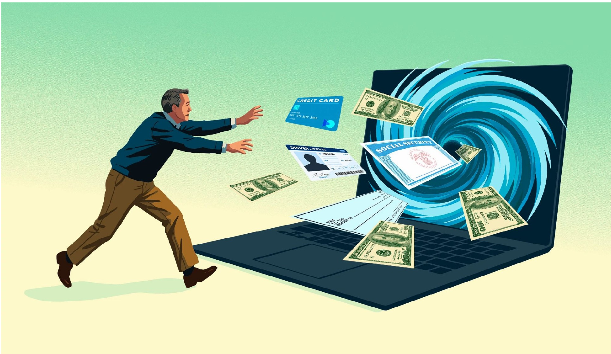
“Familiar frauds are more sophisticated, and some disturbing new schemes are emerging”
Key Takeaways
It’s important to understand criminals’ latest tactics as AI makes fraud harder to spot.
Recovery scams involve criminals targeting victims, promising to help them recoup their losses.
Employment scams, romance scams, and sextortion are among the other schemes to watch for.
The caller said he worked for a relief check company. “Our records show you may have $5,286 waiting in a relief check that’s already been issued in your name, but has not yet been collected,” he said in messages that reached phones nationwide. “This could be from past relief programs or federal assistance payments … Search your name and collect it before it’s returned.”
The call was a scam. The supposed relief-payment site asked you to enter personal information as a way to collect your data and flood you with spam. Over a two-month period in the fall of 2025, the Better Business Bureau (BBB) received more than 800 complaints about the calls.
In a tough economy, financial-relief scams like this one could become more prevalent, predicts Eva Valesquez, CEO of the Identity Theft Resource Center. This could include scams ranging from bogus health insurance to phony job offers and tariff relief schemes. “People will be looking for ways to alleviate their burdens,” Valesquez says of 2026. “So when they get a [message] that says, ‘Hey, apply here, just send us this information,’ and it’s all of your personal information, including your checking account, I think they’ll be vulnerable to that.”
Fraud is already rampant. Since 2020, the number of adults age 60 and older who reported a loss of $10,000 or more from impostor scams alone more than quadrupled in 2024, according to the Federal Trade Commission (FTC). Reported losses of $100,000 or more jumped from $55 million to $445 million during that same period, but because fraud is known to be vastly underreported, the actual numbers are surely far higher. And AI’s growing ubiquity will only worsen the problem in 2026, Valesquez surmises.
“The sophistication level of AI will make it that much harder for people to discern legitimate from illegitimate, real from fake,” she says. “I hate to say this, because I sound like such a cynic, but I encourage people to adopt a zero-trust attitude.”
What scams are likely to be most problematic in 2026? Fraud experts cite these five.
1. Employment scams
U.S. employers laid off more than 1.17 million workers in 2025, the most since the 2020 pandemic. Because of that, “Employment scams are making a big comeback,” says BBB spokesperson Melanie McGovern. And as a rough labor market extends into 2026, desperate job hunters may be more susceptible to fraud, including bogus jobs in online ads, on social media and job search websites.
Some scammers also impersonate real employment agencies and companies. Their goals: To obtain personal information or money by requiring you to pay a fee.
How to stay safe:
- Never pay a fee. If you’re required to pay money to get a job or an interview, it’s a scam.
- Distrust big promises. Be highly suspicious of guarantees of great pay and few hours for a work-from-home job.
- Understand job-app risks. Reputable sites like LinkedIn and Indeed aren’t immune to fake job posts.
- Scrutinize the source. If a recruiter contacts you, check the company’s website and see if they’re hiring for that particular position and if the person actually works there.
- Be careful when posting your résumé. “Think about what you’re publicly posting,” says Amy Nofziger, senior director of victim support with the AARP Fraud Watch Network. “A criminal could use information to manipulate you.”
2. Recovery scams
In recovery scams, criminals return to victims with promises to recoup their losses by charging fees for their nonexistent services. “I think we’re going to see a lot of recovery scams,” Nofziger says of 2026, pointing to the continued growth of scams as a whole, particularly pig-butchering or financial-grooming scams (criminals, usually based overseas, carefully foster an online relationship with a victim to create feelings of trust, then lure them into bogus cryptocurrency investments). Once victims realize they’re in the midst of a scam, they often tell the criminals that they’re calling the police. The criminals note this — “They probably record every conversation,” Nofziger says — then follow up weeks later posing as someone from law enforcement, a consumer advocacy organization, a law firm or a government agency.
How to stay safe:
- Watch for upfront fees. Criminals may charge in advance for their fake services and ask you to pay with gift cards, cryptocurrency, wire transfers or Venmo.
- Beware of phony checks. Scammers will sometimes send a counterfeit check, often for more than what you lost, the FTC notes. Then they’ll say they overpaid and instruct you to return the balance.
- Do your homework. Search the recovery firm’s name using keywords such as “scam,” “fraud” or “complaint.”
3. Digital arrest
The process is terrifying. You receive a call saying that you’re the subject of a criminal investigation. It might be a police officer charging you with money laundering. Or maybe it’s a customs official claiming they intercepted drugs en-route to your home. Bogus law enforcement officers then interrogate you on video calls, not just for hours, but days, as they threaten you with criminal charges
and pressure you to pay settlements or fines. “It’s a terror-based scam that involves holding a person digitally captive,” says Frank McKenna, chief fraud strategist with Point Predictive in San Diego, California. “They’ll get you in a video call, and they won’t let you go — they’ll basically transfer you from person to person.”
Digital arrest is an enormous problem in India that’s starting to spread to the United States, McKenna says. In India, digital arrest scams and related cybercrimes nearly tripled from 2022 to 2024, the Indian government reported in March 2025. In September, a retired doctor in Hyderabad died from a heart attack after enduring nearly 70 hours of digital arrest and constant video surveillance, India Today reported.
Scammers use AI “to create deepfake videos and forged documents, including court orders or arrest warrants, to deceive victims by making their threats appear more credible,” according to ISACA, an association for information systems/information technology professionals. Unlike a romance scam, where criminals may spend months building a rapport with their victims, scammers use intimidation and threats to steal your money. Such scare tactics are increasingly appearing in a growing number of scams. “We’re seeing a lot more overzealous threats to victims,”Nofziger says. “Very aggressive: ‘I’m going to kill you. I’m going to kill your family.’ We’ve had victims
who have gotten pictures of dead bodies and pictures of car accidents saying, ‘This is what’s going to happen to you.’ ”
How to stay safe:
- Hang up. “Law enforcement doesn’t call people and threaten to arrest them,” McKenna says. “If you get a call like this, hang up.”
- Remember how the system works. Court orders or arrest warrants are not delivered through phone calls, emails or social media messages, ISACA notes.
4. “Hello pervert” scams
Most scams aren’t new. They’re often old frauds that resurface with new twists. That’s the case with a “Hello pervert” scam. Criminals email to say they’ve hacked your computer and recorded you visiting porn sites. If you don’t pay them, they’ll share evidence of your naughty behavior with your email contact list. To increase the pressure, scammers might include photos of your home (to make you feel
like you’re being watched) and spoof your email address, so it appears that the blackmailer is contacting you via your own email account, according to Malwarebytes, a cyber protection company.
“We’ve seen a spike in these ‘I know what you’re doing on your computer’ kind of scams,” says AARP’s Nofziger. One possible reason is the Jeffrey Epstein scandal. Scammers often exploit subjects that dominate the news (heavy media coverage about bankruptcies, for example, might lead to bankruptcy scams). Such scams also tend to follow data breaches. Scammers obtain personal info, which makes the threat seem more legitimate. “These are highly personalized messages that scammers use to extort you based on information they
find in data breaches,” McKenna says.
How to stay safe:
- Pause before acting. “These messages are not real,” says McKenna. “The best thing is to delete them and not respond.” Also, if you reply, the scammers know that your email address is active — and they’ll likely send more messages.
- Never open attachments from unsolicited emails. Blackmail messages are frequently sent as PDFs to bypass phishing filters.
- Stay calm. Blackmailers may demand payment within 24 hours, but urgency is a frequent scam tactic.
5. Romance scams
Romance scams aren’t new, either, but they are Nofziger’s most significant concern for 2026 because of their relentlessness and prevalence — and the devastation that often follows. They follow a familiar pattern. A scammer, frequently known as a cat-fisher, assumes a false identity and forms relationships with victims through dating apps, messaging apps and social media. Once they establish trust, they will ask for money or suggest investments in cryptocurrency. Some scammers attempt to build connections by leveraging mutual interests, which they can easily find through your social media accounts. If you’re in a running group, the scammer might claim to be a runner too. If you recently traveled to Paris, the criminal will share their own experience strolling the Champs-Élysées. They might also profess to be a long-lost friend. “We’re starting to call them friendship scams instead of romance scams, because a lot of times now it’s somebody wanting to be your friend and talking you up,” says McGovern. “And then there’s the ask of, ‘Hey, I’m investing in this great crypto platform. You should get involved too.’ ”
How to stay safe:
- Ignore wrong numbers. Scammers will sometimes call or text seemingly by mistake. Once you respond, they’ll start a conversation.
- Stay on the platform. Your new friend may want to move the conversation from a dating app or social media site to an alternative, such as WhatsApp. The reason: They don’t want the conversation to be monitored by a platform’s scam-seeking algorithms.
- Understand love bombing. It’s a common tactic: Someone overwhelms you with over-the-top adoration and affection, usually in the very early stages of a relationship. Love bombing isn’t normal — and it’s a way for scammers to control the relationship.
- Ask to meet in person. If someone can never meet face-to-face, that’s a red flag.
Article received from AARP Fraud Network. Written by Ken Budd
If you or a family member have been a victim of identity theft or fraud do not be ashamed.
Reporting the issue is the only way authorities can try to protect or make others aware.
If you are interested in hearing about how to protect yourself, your assets and your identity
contact me for more information.



Leave a Reply